

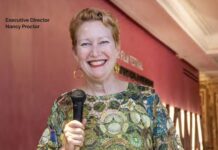





By March 2020, Erin Moran was burnt out. Between over two decades of work helping to develop positive workplace cultures at the New York City-based Union Square Hospitality Group and Great Place to Work, Moran had neglected her own well-being.
“I felt like I was sprinting a marathon,” Moran says.
The single mother took drastic action: She took a year off of work—originally planning to take her children to Europe before COVID foiled her plans—traveling around the U.S. with her two children, homeschooling them and learning to find a balance again between life and work.
As the inaugural executive director of the Dr. Nancy Grasmick Leadership Institute at Towson University, Moran, 47, helps train tomorrow’s leaders to develop those same boundary-setting skills she learned from her sabbatical. Inspired by Grasmick, the former superintendent of the Maryland State Department of Education, Moran believes that good leaders are developed and invested in, not born.
Q: Where did your interest in self-improvement and leadership come from?
My passion for leadership probably started when I was working at Great Place to Work. My initial hypothesis earlier on in my career was that great workplaces had really great perks and benefits, like the onsite gym or the really cool offices with the lava lamps and beanbag chairs. … And what I realized was that it’s none of those things. It is all about great leadership.
Q: How has being a single mom informed your leadership philosophies?
A: Being one person with two children, the boundaries for me of getting home and being home for dinner with my kids were not negotiable for me. And so I felt almost unapologetic in my commitment to leaving work and getting home to be with my kids.

What I learned over time was that by me as a leader doing that, it created the space for other people to feel empowered and safe to make that type of decision for them, even if they weren’t a single parent.
Q: What did you learn about yourself during your yearlong sabbatical?
A: My professional identity had somehow become my own personal identity. And I needed to recognize that they should be separate, and that my professional accomplishments I’m proud of, … they don’t define me as a human being.
I had to rebuild my relationships with my kids, and that also was quite a learning experience because we were together 24/7. And so I had to learn how to communicate differently with them and to connect with them differently. I learned more about them because they were, over time, willing to share more about what they had experienced and were thinking and were feeling.
Q: Others may not have the resources to take time off work or travel. What are some ways to reap similar benefits of a sabbatical while still juggling a busy life?
A: My recommendation would be …to not beat ourselves up and say, “I’m a bad person,” if I’m taking care of myself. No, you’re building resiliency, and in so doing, you will be able to be a better contributor, parent, partner, community member.
Each one of us has a finite set of energy within us and to be thoughtful about how we spend that energy. I was under the misconception that I had a limitless volume of energy that I could expend. And it’s simply not a physiological fact. It’s a finite set. It’s mental; it’s spiritual; it’s physical, but it’s finite.
Q: What makes a good leader?
A: Leadership is about being intentional. It is about being an effective communicator. It’s about having an incredibly high level of self-awareness and emotional intelligence. And that takes an investment and training and skill-building, and it evolves over time.