





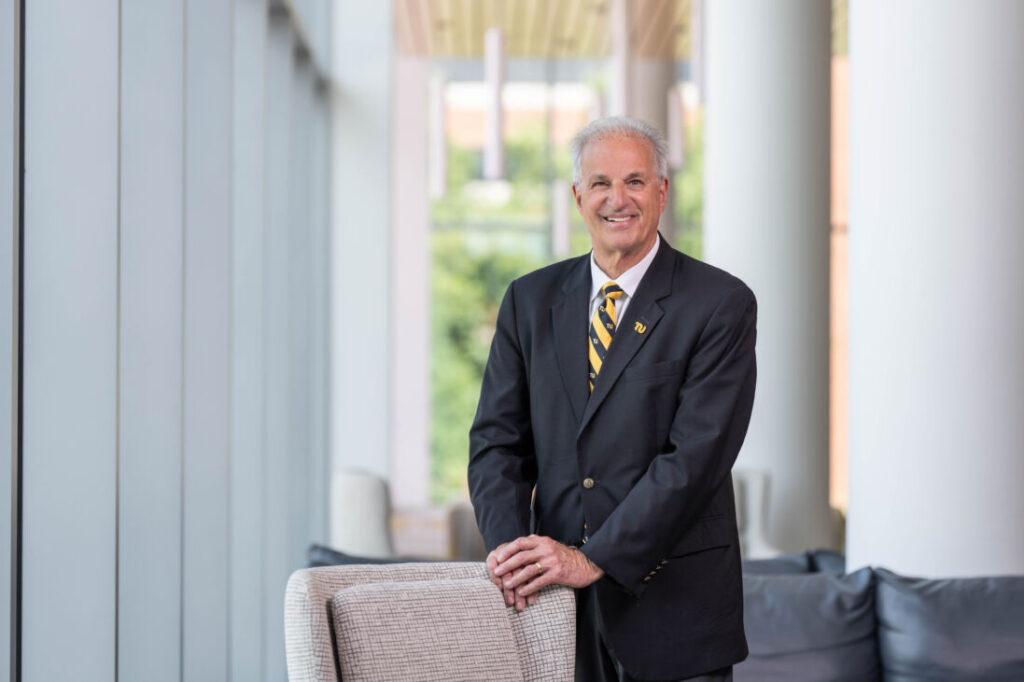
Dr. Mark Ginsberg’s passion for education began in the 1970s while he was an undergrad at the University of New York at Cortland working towards his bachelor’s degree in psychology. It was then that he got the opportunity to work at an elementary school as part of a practicum project.
Ginsberg has since spent the last four decades working in the fields of psychology and education with a focus on children and families — having spent 13 years at George Mason University, serving as provost and executive vice president since 2020. In 2023, Ginsberg assumed his current role as the president of Towson University, which was recently named by the Wall Street Journal as the No. 1 public university in Maryland and the No. 15 public university in the nation.
Engine of Opportunity
Ginsberg says that one of his major motivations to get involved in education was a desire to provide children and families with the resources to thrive in their lives rather than deal with the problems that arise afterwards if they don’t have that access early on.
And that’s what Ginsberg has been trying to do at Towson, which he says is reflected in the WSJ ranking because of the high social mobility and workforce development the university has given students.
Ginsberg adds that the university has typically been known for its education and nursing programs but is growing its other programs in high-demand fields so that it is well-rounded for students with varied interests and fill gaps in the local workforce.
“More than 90% of our students stay in Maryland after they graduate. We’re an engine of opportunity for the state,” Ginsberg says. “We’re going to continue to try to think about where the gaps are and how we can fill those gaps and meet the needs of the state, both today and in the future.”
Training the Next Generation of Teachers
Ginsberg highlights the Towson education program as one example of the school’s position as an “engine of opportunity” and the importance that the university places on creating a well-trained next generation of teachers.
“We have fewer people going into education today than we did a decade ago,” Ginsberg says. “For the state’s economy, but, more importantly, for the ability for the state to thrive in the future, that has to increase, and so we’re doing everything we can to work with school systems, the Maryland State Department of Education, and with those who are organizing and leading the blueprint for the future of Maryland.”
Inspiration From the Students
Ginsberg also spends a lot of his time on campus interacting with students and says that the passion for the university is shared with staff across the board, which makes the school an energetic place where people want to be.
“People who work here are very committed to the students they serve, and I think it’s an inspiring place to be,” he says. “I’m on campus all the time. I live in a residence hall, so we are with students every day, all day, and that’s been important for me to be really connected to our students and to get the pulse of the campus on an everyday basis.”
Ginsberg also speaks on the highly diverse community of students at Towson and the importance of his mission to be a “president for the entire community” on campus.
“To be integrally involved as part of a community is very important to your success, [and] I think was important to my success as a student, was important to my success as an adult, and I know it’s important for our student success,” Ginsberg says.
He states that shared community across the campus was a major point of pride and has been a place where people can grow alongside the university.
He adds that the university still has a tremendous amount of potential for future growth despite the high rankings they’ve attained in the past year.
“I’ve learned to really appreciate the potential for the university to continue on this incredibly positive trajectory …We are a university that is driven by inclusive excellence, and whether it be the challenges of last fall and spring or the challenges of next year and the years ahead, this is a place where students, faculty and staff can really fulfill their potential,” Ginsberg says.