



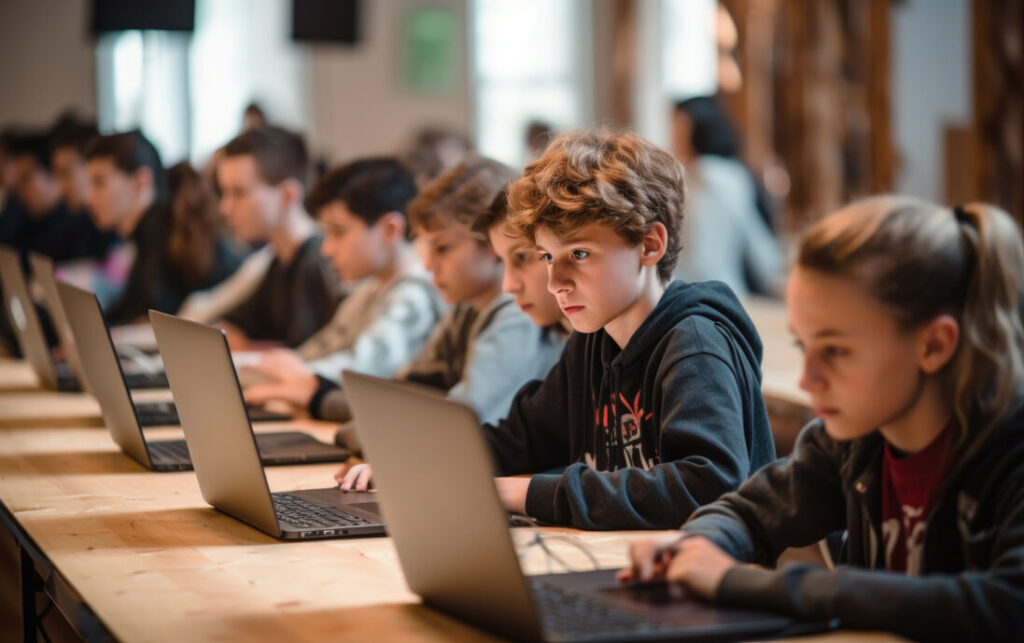
Maryland public schools in the greater Baltimore area haven’t had the easiest adjustment to the Artificial Intelligence era. AI-related controversies have dogged both students and administrators in and around Maryland’s largest city.
In late May, south of Baltimore, an Anne Arundel County Public Schools student was cleared by her school system of claims the high school junior used artificial intelligence to cheat on an assignment.
A few months earlier, a former Pikesville High School principal sued Baltimore County Public Schools over a racist AI recording police say was wrongly attributed to him.
Per authorities, the recording was actually created by a disgruntled ex-campus athletic director to frame his former boss.
It’s all part of an academic and campus growing process when it comes to incorporating AI into classroom instruction and school life. After all, many teens admit – sometimes forthrightly and often reluctantly – they use AI to cheat on assignments, homework, or tests.
There are many generative AI models that can be used for free, most notably ChatGPT. The pioneering chatbot offers image and video generation and can be used through mobile and computer apps, as well as via ChatGPT.com.
Teenagers and young adults are usually way ahead of their parents and other adults in technology, which makes it difficult to regulate their AI use.
The transition to incorporate education technology is one that BCPS and many school districts in the region are confronting cautiously.
“We have a pretty strict policy that prohibits the use of Al for assignments,” said BCPS spokeswoman Gboyinde Onijala in an email.
Whether that approach remains feasible is an open question because AI is becoming incorporated increasingly in college-level coursework.
The Ohio State University is making AI literacy a requirement for all undergraduates, starting in 2025, the Columbus campus said in early June.
The University’s new “AI Fluency” initiative includes hands-on workshops and a dedicated course, aiming to equip students to use generative AI responsibly in their chosen fields of study.
OSU, one of the nation’s largest universities, is the first school to do this. But Baltimore-area students are likely to soon feel its effects, though some professors have been grappling for years with the changes in traditional teaching and learning methods and the role of AI in student coursework.
“The COVID-19 pandemic and move to online teaching was the first major disruption. The idea that you couldn’t talk to students directly about their writing, and talk face-to-face, impacted the quality of student product,” said Carolyn Forestiere, professor of political science at the University of Maryland, Baltimore County.
Issues of writing quality, or lack thereof, only accelerated when ChatGPT emerged in 2022 as the first widely available AI system, Forestiere said in an interview.
“Since joining UMBC in 2004, I have taught up to 2,000 students. I have read a lot of student papers, and all of a sudden, I’m seeing expressions and words and sentence structures that I have never seen before,” Forestiere said. “When you’re asking students to connect ideas and disparate facts and come up with a conclusion on their own, we can get into trouble with excessive AI use.”
But like it or not, AI is becoming integrated to college instruction.
And it’s a problem that public high schools are shunning AI. Many UMBC students are graduates of local high schools, and the no-use policy by Baltimore County Public Schools doesn’t help students once they reach college, Forestiere added.
How AI can be used properly and responsibly in Maryland public schools is the subject of legislation making its way through the state legislature in Annapolis.
The State Department of Education would be required “to conduct an evaluation on the use and potential use of artificial intelligence in public schools,” under the bill sponsored by State Sen. Katie Fry Hester, a Democrat whose district covers parts of Howard and Montgomery counties.
The proposal would require a survey a local school systems to review current coursework AI uses and how it affects student learning, with a final report due by Dec. 15, 2026.
“Is there a version or some kind of technology that schools can use to have some kind of guardrails on, so that kids can play around with it without getting hurt? Whether it’s ChatGPT or something else,” Fry Hester said in an interview. “Teachers, superintendents and, of course, parents — everybody wants it to be figured out.”
There’s already reason to think AI use in education has logical limits. A study in the journal “Nature Human Behaviour” by a pair of professors at The Wharton School of the University of Pennsylvania found that subjects came up with a broader range of creative ideas when they relied on their own thoughts and web searches, compared to when they used ChatGPT.
Still, results of the Maryland state study on the use of AI in public schools, and others like it, will surely trigger tough questions about the role of technology and education, something academics are already focused on.
“I liken it to the start of the calculator. A tool was developed that made obsolete the previous kind of thinking,” said UMBC’s Forestiere. “What AI is going to do is force us to think through how we administer education.”