





Hearing loss rarely announces itself all at once. More often, it slips in quietly — a missed name at a family gathering, a television turned up a little louder, frustration in restaurants where conversation feels harder to follow.
By the time many adults seek help, they have been compensating for years. That slow adjustment often begins with subtle misunderstandings.
Those small shifts in clarity are often the first measurable signs of change. “An early sign that people dismiss is poor speech clarity,” says Dr. Lachelle Lazarus, an audiologist at the University of Maryland Medical Center in Baltimore. “It’s the difference between ‘cat’ with a ‘T’ and ‘cap’ with a ‘P.’ Those subtle differences can be an indication of hearing loss.”
Hearing loss is one of the most common chronic conditions in the United States. More than 50 million Americans — roughly one in seven adults — have some degree of hearing loss, according to the Hearing Loss Association of America. Yet it remains widely overlooked.
People often begin by asking others to repeat themselves. They may blame poor acoustics or accuse family members of mumbling. Ringing in the ears, known as tinnitus, can also signal a change. Lazarus, whose specialty includes tinnitus care, says it is often the brain’s response to reduced sound input.
Another clue is reliance on visual cues. If someone struggles more when a speaker turns away or covers their mouth, that may indicate hearing difficulty.
“Hearing loss related to aging starts in many people around the age of 40, but we mostly don’t see it noticeably until the mid-50s or 60s,” says Dr. David J. Eisenman, an ear, nose and throat physician at the University of Maryland Medical Center in Baltimore who specializes in diseases of the ear.
Most adult hearing loss reflects a mix of genetic and acquired factors.
“By far the most controllable and potentially modifiable cause of hearing loss is noise exposure,” says Eisenman, who is also a professor of Otolaryngology–Head and Neck Surgery at the University of Maryland School of Medicine in Baltimore.
Constant access to music through earbuds and headphones has shifted the risk, particularly among younger people.
“Hearing loss related to noise is generally related to the loudness and duration of exposure,” Eisenman says. “Both of those have increased nowadays.”
Lazarus says much of that damage is preventable with consistent hearing protection.
When changes are suspected, experts recommend evaluation rather than assumption. Even if hearing loss appears age-related, Eisenman says, it should be assessed.
“Hearing loss generally creeps up very slowly, and people adjust over time,” he says. “That doesn’t mean they’re doing well. Those adjustments can be counterproductive.”
He advises medical evaluation particularly if hearing loss is worse in one ear, or accompanied by balance problems, headaches or ringing in only one ear.
A hearing evaluation includes both a medical exam and a formal hearing test, known as an audiogram.
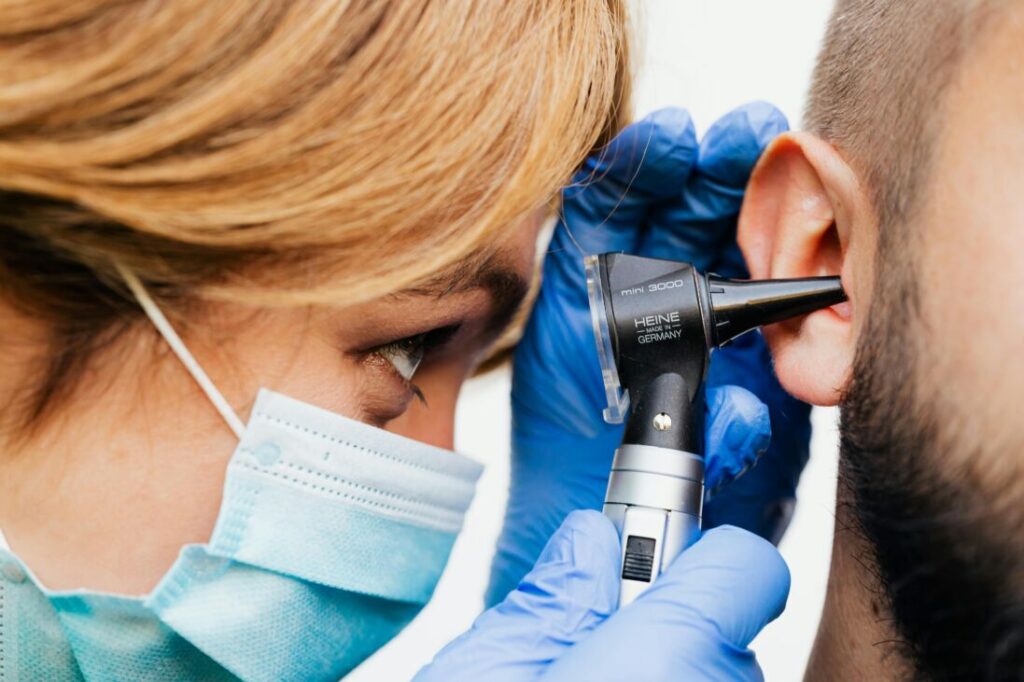
Lazarus begins with otoscopy to examine the ear canal. Tympanometry measures eardrum function and can reveal middle-ear problems. Reflex testing evaluates how the ear responds to sound. Speech testing assesses clarity and understanding at comfortable listening levels.
“We’re looking at the softest level of sound you can hear at different pitches,” she says, “and how well you understand speech.”
If hearing loss is confirmed, hearing aids are often the first line of treatment, particularly for age-related degeneration of the inner ear’s hair cells.
“Hearing aid technology now is outstanding,” Eisenman says. “Far, far better than it was 20 or 30 years ago.”
Modern devices are smaller, more comfortable and less noticeable than earlier generations. They are programmable for different listening environments and can stream phone calls and media directly to the wearer’s ears.
Lazarus says the biggest recent improvement has been performance in background noise.
“They are more aggressive in the noise reduction and trying to provide more speech clarity in the presence of background noise,” she says. “That’s where people struggle most.”
Artificial intelligence has further refined how devices distinguish speech from competing sounds.
Still, hearing aids are not the answer for everyone. For individuals with severe hearing loss or poor speech understanding even with amplification, cochlear implants may be considered.
“If you’ve tried hearing aids and they’re not working, that’s often an appropriate time to think about a cochlear implant,” Eisenman says.
Cochlear implants bypass damaged portions of the inner ear and directly stimulate the auditory nerve. Candidates may include individuals with profound hearing loss in both ears or single-sided deafness, Lazarus says. Duration of hearing loss and prior hearing aid use are also important factors.
Untreated hearing loss can affect more than communication.
“There’s a lot of data nowadays on cognitive function and hearing loss,” Eisenman says. “If you just assume it’s age-related and there’s nothing to do about it — which is not true — you’re putting yourself at risk of other issues, in particular cognitive dysfunction.”
Lazarus describes it as a “use it or lose it” principle. Without adequate stimulation, the auditory system can lose efficiency in processing sound. Social withdrawal often follows, increasing the risk of isolation and cognitive strain.
Technology can help bridge the gap. Smartphone apps offer real-time voice transcription. Captioned calls and streaming features reduce the mental energy required to follow conversations.
“These tools can decrease the mental strain that one has with hearing loss,” Lazarus says. “There’s less cognitive load just trying to hear and understand.”
Cost remains a concern. Hearing aids can cost several thousand dollars per pair. Traditional Medicare does not cover them, though some supplemental health plans offer partial benefits.
For patients who feel overwhelmed, Lazarus encourages taking small steps.
“Just doing a hearing test does not commit you to getting hearing aids,” she says. “It provides a baseline. You can take it one step at a time.”
Hearing loss may be common, but it is treatable. With evaluation, prevention and advancing technology, most people can remain fully engaged in their families and communities.
“You should consider yourself fortunate to have a medical problem that’s treatable,” Eisenman says. “There are so many options now that you shouldn’t be anxious about it — you should be excited that it’s something we can address.”