



Fayette and Monroe might be the most famous — or infamous — corner in Baltimore. Three decades ago, on the stoops of this West Baltimore neighborhood, a pair of young Baltimore Sun reporters hung out, observing the hidden-in-plain-sight drug transactions and too many hangers-on felled by addiction, gang warfare, lack of social and educational services, and just plain societal neglect.
This corner became the starting point for an acclaimed television account of crime and punishment, misdemeanors and felonies, private and public maleficence in Baltimore, marking the city beloved for its charm and quirkiness as a crime-ridden drug haven.
Sun crime reporter David Simon, who grew up in the Washington, D.C., suburbs, studied journalism at the University of Maryland before introducing the inner-city Baltimore crime beat to television as a torn-from-the-headlines cable television series. “The Wire” became an acclaimed sweeping procedural drama that bared the institutional flaws in the police force, the city’s politics game, the seaport system, public education, and newspaper journalism, all intertwined with the illegal dealings with the
drug trade.
The HBO series, which aired from 2002 to 2008, has oft been praised as the best ever drama on television. During its heyday it inspired a course on urban inequality at Harvard University. With its ruthlessly realistic characters and West Baltimore settings, the series later influenced a generation of prestige television dramas, including shows
such as “Breaking Bad.”
While “The Wire” was based on actual reporting, S. Rasheem, an independent scholar and social scientist, says, “I would say at best, ‘The Wire’ is historical fiction. I do feel it is entertaining … but it wasn’t factual … even if thousands of people loved it. It’s not an accurate portrayal of life here … The city is the main character and it did not tell the full story of this city.”
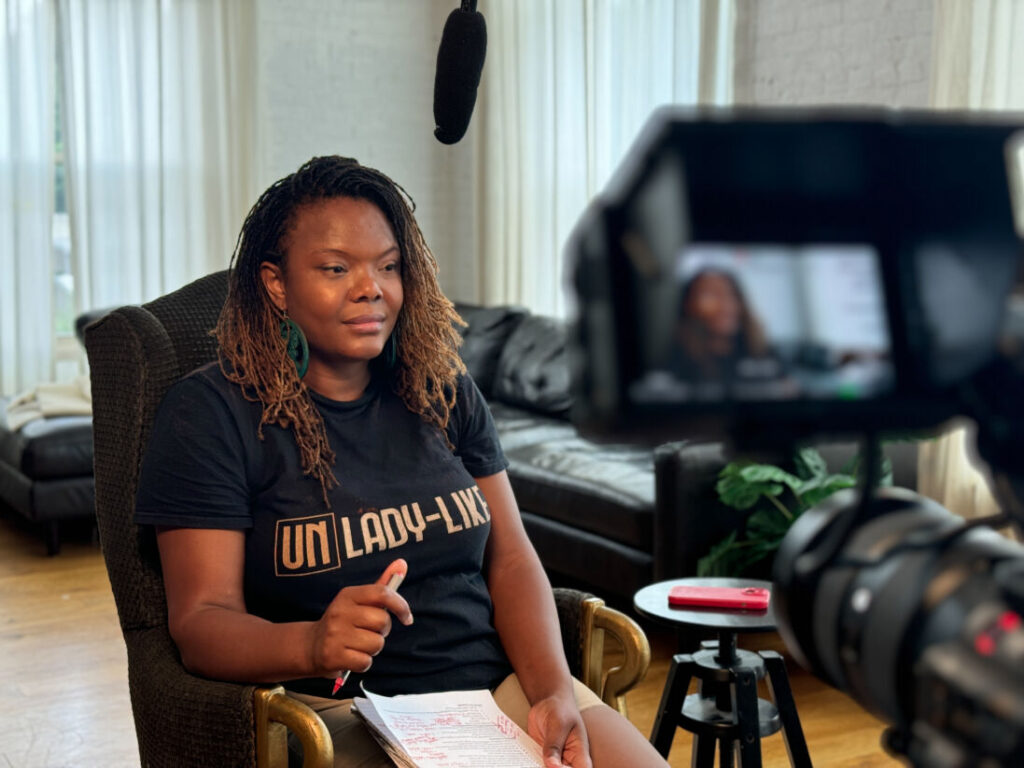
Now she has a response in the form of her world-premiere documentary “Beyond the Wire,” which focuses its lens on aspects of the Baltimore story that the five-season series left out. She says the project came about “simply because I’m a researcher by socialization and training. Much of my research is published in academic journals, behind a paywall, read by other scholars, academicians or policy people.”
She left behind the academese to share this story of often overlooked actions and community service groups that have made a difference, both in the crime and drug rates in these neighborhoods, and, more importantly, in the lives of those who lives have been touched.
“There are implications for policy, for programming, for education in my work,” she says. “But the people who need to see that can’t always get it. I wanted to make this information consumable to a wider audience beyond academia … The best way was to make a film.”
Baltimore Legacy Project
“Beyond the Wire” premieres June 18 at the Senator Theatre; the filmmaker/researcher hopes additional screenings will be scheduled nearby and around the country. Rasheem spent nearly a decade researching, interviewing, filming and editing as part of her Baltimore Legacy Project, with the goal of giving voice to African-American Baltimoreans’ stories.
BLP includes interviews that capture the stories and lived experiences of Black Baltimore from 1950 through 2024, while also contextualizing the historical events of the period and the legacies and wisdom of Black elders. Rasheem views this research and collection as a means of capturing the cultural essence of communities and people whose histories and contributions have been overlooked or re- and mis-told by outsiders.
Her first film, “Baltimore Still Rising,” shared the reflections of 20 Baltimore residents who experienced the 2015 uprising after the death of Freddie Gray at the hands of police.
“Beyond the Wire” is her latest entry in the BLP, capturing the programs and voices that the writers and creatives left out of the television series. For Rasheem, the show feels one-sided, ignoring individuals and neighborhood programs and communities that worked to change and save lives in West Baltimore during and following the peak of the city’s drug wars in the 1980s and 1990s.
“The Wire” and numerous other stories of Baltimore over the decades have primarily been told through the lens of white men. Just like Stringer Bell, the up-and-coming drug lord depicted in “The Wire,” who leads his ranks like a corporate CEO, Rasheem wants Baltimore’s Black communities and individuals to own and tell their stories in their own words.
A Daytona Beach, Florida, native, who moved to Baltimore for college in 2009, she said she didn’t watch the full five seasons of the show until just a few years ago. The reason? For her, it overlooked entire swaths of Baltimore’s Black community. “It did not tell the full story of the city,” she says. “It missed the local nonprofits out here doing all of this work. It missed the faith community and how they are countering and mitigating some of the negative impacts [of lack of social support]. It missed the history that reflects specifically how neighborhoods got into the situations that they are in.”
Focusing on oft-ignored stories in the Black community

Community leaders Rasheem interviewed include members of the Tendea Family, a service organization advancing Baltimore’s Black community with identity, self-improvement, community-service and development programs; “Captain Andrew” Muhammad, executive director and founder of We Our Us and the founder of Baltimore Brothers, both leadership-training organizations for Black youth; Eric “EB” Brown, a community leader trained by We Our Us; Erricka “Wonder Voice” Bridgeford, activist, mediator, and co founder of the Baltimore Peace Movement; and the city-sponsored Mayor’s Office of African-American Male Engagement, which aims to promote educational, economic, and social success for Black men. These and other organizations and individuals represent the untold stories of community-based work that played a role in quelling violence, street gangs and drug dealing in the neighborhoods that inspired “The Wire” three decades earlier.
“You hear not only from Baltimoreans who say that this is not us,” about the ruthless violence depicted in the show, Rasheem notes, “but you also hear from friends or colleagues of people who are depicted, saying, ‘Man, they made [him] seem like a monster,’ or ‘They made us seem like we killed for money. We never killed for money. It was always if you offended or attacked someone in the family, we addressed that. But we never killed for money.’”
As a documentary “Beyond the Wire,” which came together in just 18 months from idea to finished product, is intended to be far more than a good story about a bad period in Baltimore’s history. Instead, Rasheem hopes that this film will activate further growth and change to neighborhoods without displacing longtime residents.
“My hope [for ‘Beyond the Wire’] is that the further this film goes, Baltimore will prove to be a model for supporting historic drops in crimes, a model for demonstrating how it’s done,” Rasheem says, adding, “I hope it counters some of the negative stereotypes that people have about Baltimore. I hope that this is part of an effort that will attract people back who love the city. I hope that it will reduce brain drain, because people come here, get an education, and then leave. I hope that leadership will invest in the organizations, churches, faith leaders and community who were part of the boots on the ground that brought down the historic high crime.”
But fundamental changes can’t occur without committed support beyond West Baltimore blocks and neighborhoods, Rasheem says. “We need city leadership in Baltimore to align with our neighborhoods and communities in order to move forward and to keep continuously growing.”
As for film documentation, following this premiere, Rasheem plans five more documentaries on the city she’s come to love, to complete this legacy series. “We trust outside analysis over the people themselves, and that is a problem,” the documentarian says. “No matter how entertaining it is, no matter how much we like it as art … that is the reason why this film needed to be done.”
“Beyond the Wire” by S. Rasheem screens (June 18 screening is sold out) Thursday, June 25 at 7 p.m., Senator Theatre; Saturday, Aug. 29 at 2 p.m., Parkway Theatre. For information and tickets, visit Beyond the Wire New – Baltimore Legacy Project.
Lisa Traiger is an award-winning arts journalist who has written for The Washington Post, The Kennedy Center and numerous other regional publications.