




A Doorway to Memory and Marvel
It was an overcast Baltimore afternoon when my wife, Nataliya, and I stepped through the doors of the Walters Art Museum, one of the few places in the city where the weather doesn’t matter and the experience is free for all.
We were there for a quiet day together, and although we didn’t have a specific exhibit in mind, I had my usual mental map: the Barbizon landscapes, the Impressionists, the serene hush of the Egyptian galleries, Islamic art, Christian artifacts, and the Chamber of Wonders — full of intricate oddities and charm.
The Museum That Feels Like Home
The Walters has long been a favorite of mine in Baltimore. That’s saying something in a city with world-class institutions like the Baltimore Museum of Art and the Visionary Art Museum.
There’s something about the Walters — its scale, its quiet elegance, the sheer variety of art spanning centuries and continents — that makes it feel like a place where you can never see it all yet always feel at home.
When my children were young, we brought them here often. My son was captivated by the suits of armor and mummies. My daughter lingered in the sculpture court, tracing the folds of stone robes with her eyes.
It became a tradition: a Saturday morning visit to the Walters followed by a picnic lunch on a bench in Mount Vernon Place’s Long Green, admiring the statues and fountain.
Now, visiting with Nataliya, the museum holds new meaning — not just memory, but fresh appreciation.
Art Collectors With Vision
The story of the Walters is itself worthy of a museum exhibit. William Thompson Walters, a wealthy railroad magnate, began collecting art in the mid-19th century, building a private collection that was as eclectic as it was expansive.
His son, Henry Walters, inherited both the wealth and the passion for collecting and greatly expanded the holdings with pieces from Europe, the Middle East, and Asia.
When Henry died in 1931, he left the entire collection — more than 22,000 pieces of art — to the city of Baltimore, along with the building that housed it.
That legacy has grown into a public collection of more than 36,000 objects, many of which are displayed in the museum’s elegantly curated galleries.
Barbizon Shadows and Impressionist Light
One of the great joys of the Walters is how it invites wandering. Nataliya and I found ourselves in the 19th-century European galleries, standing before a moody forest scene: “The Storm” by Narcisse Virgile Diaz de la Peña.
Nearby, “Landscape with Gleaners” by Charles-François Daubigny captured a tranquil edge-of-the-forest scene, its brushwork gentle and Tonalist.
These Barbizon masterpieces, often overlooked, are among the quietest triumphs in the museum.
Around the corner, Gustave Courbet’s realist works confronted us with earthy, muscular scenes that seemed to breathe with life.
Then came the Impressionists. I looked for the familiar work by Childe Hassam, an old favorite from past visits, but it wasn’t on display this time. There are so many pieces, some rotate in and out of storage.
We admired soft, luminous canvases by Monet and Sisley, their pastel hues radiating from the walls with gentle insistence.
Christian Art and the Colosseum’s Grim Spectacle
Another painting I sought out from memory was “A Christian Martyr’s Last Prayer” by Jean-Léon Gérôme, that sweeping, chilling canvas of early Christians huddled in the Roman Colosseum as lions approach, an image that once stunned my children into silence.
The Walters also features a remarkable stained-glass window glowing with soft color, casting prismatic light across the floor.
Nearby are crucifixes, medieval altarpieces, carved reliquaries, and illuminated manuscripts. The collection of Christian art and relics settled over us like incense.
Islamic Art With Geometry in Its Lines
The Walters isn’t limited to European works. Its Islamic Art gallery is a quiet marvel — intricate ceramics, shimmering tiles and luminous manuscripts displayed in soft lighting. The attention to detail is breathtaking.
Nataliya lingered in front of a 16th-century Persian miniature, its vibrant pigments and delicate lines drawing her in.
Echoes From the Nile
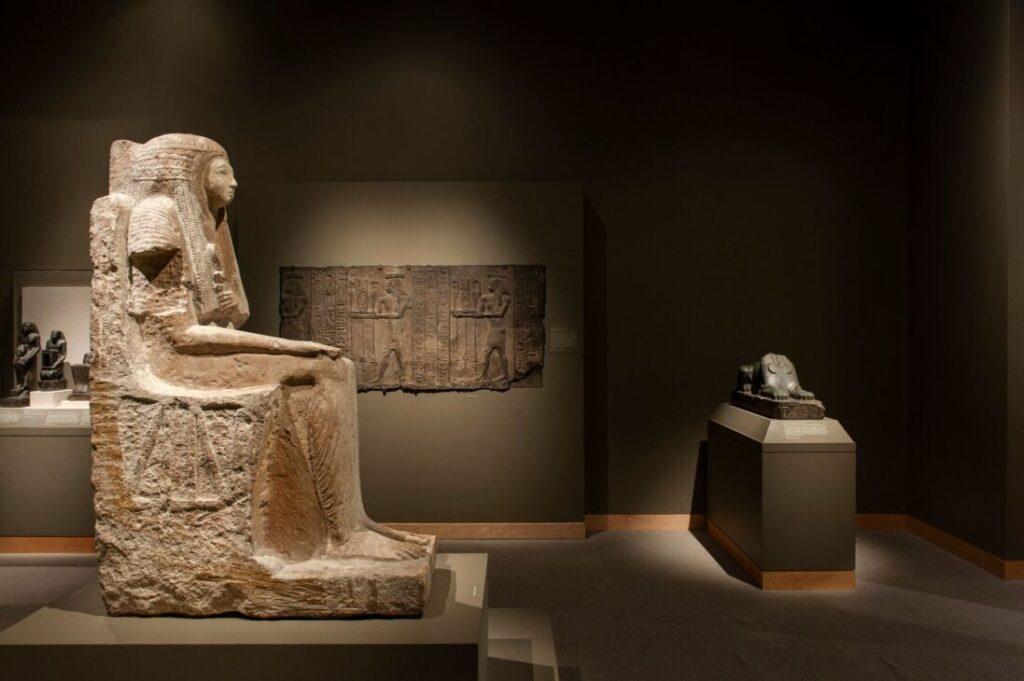
We made our way to the Egyptian gallery, where timeless artifacts rested in dimly lit cases. The mummies, always a favorite with children, were still here, still evoking wide-eyed awe. But as an adult, I was drawn more to the sarcophagi and statues — the craftsmanship, the inscriptions, the sense of eternity carved into stone.
Zen and the Art of Looking Slowly
One of the museum’s strengths is the way it presents Asian art: serene Buddha statues from China and Japan, intricate lacquerware, ceremonial bronzes, and ancient scrolls. The galleries have a meditative quality.
The Asian collection also includes exquisite Indian art — sculptures of Hindu deities like Kali and Vishnu — carved in stone, bronze and wood; illustrated manuscripts; and decorative objects that reflect a deep spiritual and aesthetic tradition.
Cabinets of Curiosity and a Hall of Knights
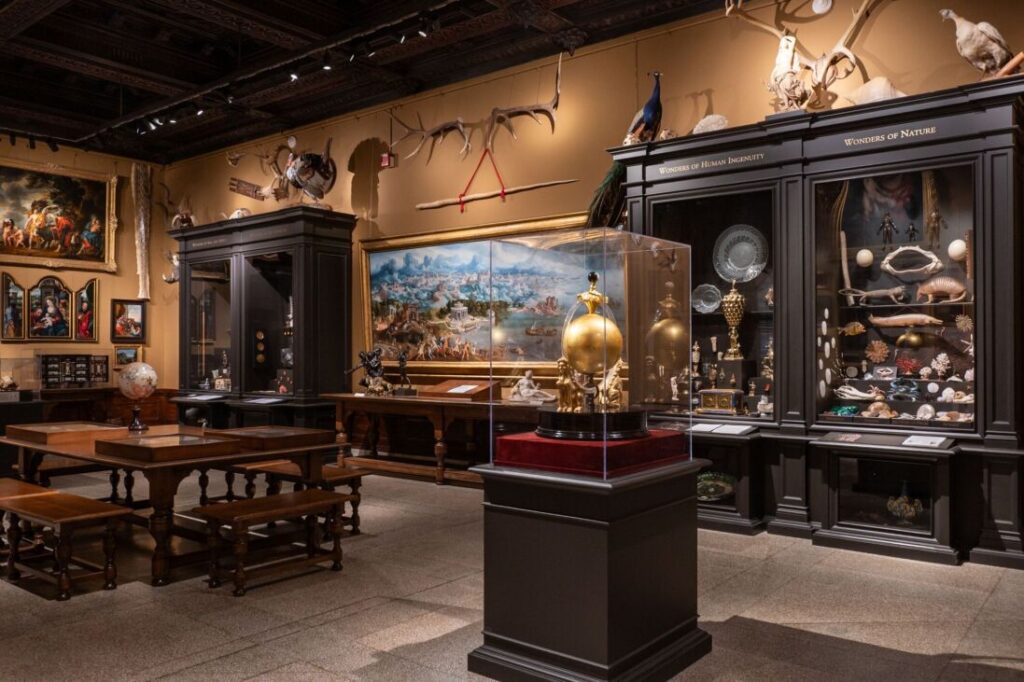
From there, we ventured into one of my favorite corners of the museum, a re-creation of a Renaissance-era study, lined with wood-paneled cabinets and drawers labeled with careful script.
This Chamber of Wonders is a time capsule of curiosities: preserved butterflies pinned in ornate arrangements, tiny skulls and seashells, taxidermied birds and insects, and strange marine creatures in jars.
Nataliya leaned over a case displaying an armadillo shell beside a carved nautilus, marveling at the juxtaposition of nature and art.
Next to it, we wandered into a small library-like space, where shelves of rare books shared room with miniature bronzes, ivory carvings and delicately painted trinket boxes. It felt like discovering a collector’s private study.
Between these two rooms lies a narrow hallway of armor — gleaming helmets, shields, swords, crossbows, spears, and even ivory-handled pistols suspended in glass.
Standing before the child-size suit of armor, a perfect miniature that once fit a noble boy, I remembered my son staring at it in awe years ago, convinced it was built for a knight his age.
Looking Back — and Forward
Even as the Walters invites you into the past, it’s not stuck there. Recent visits reveal a deliberate shift toward inclusivity and contemporary resonance.
Some galleries pair Renaissance paintings with modern works by underrepresented populations — juxtapositions that encourage new conversations between eras and identities.
These additions remind us that the Walters isn’t just a treasure chest of the past; it’s also a living institution, committed to evolving and engaging new audiences while honoring the legacy that made it what it is today.
A Curated World Tour
There are marvels around every corner at the Walters: rare books and illuminated manuscripts in the Rare Book Room, opulent medieval ivories and altarpieces in the Byzantine and Medieval galleries, and Renaissance treasures that might easily be mistaken for pieces from the Vatican or Louvre.
Two Fabergé eggs grace the Walters as well as some 70 Russian crafts and objects, such as gold and silver drinking vessels, carved stones, icons, jewelry and intricate enamels.
What makes the Walters unique is not just the breadth of its collection, but the intimacy with which it’s presented. There’s no rush here. Even the museum’s grandest rooms feel personal rather than imposing.
A Bench, a Skylight and a Shared Moment
At the end of our visit, Nataliya and I paused on a bench in the court, beneath the skylight that sends soft daylight cascading down on Greco-Roman marbles and neoclassical bronzes. We sat in silence, taking it all in.
“I forgot how great this museum was,” she said, “and why we used to visit so often with the kids.”
She was right. The Walters is a place where you can touch the edges of ancient civilizations and 19th-century Paris within the same hour. Where you can be alone with a masterpiece.
And it’s close to home; there’s no need to take it all in during one rushed visit. There’s every reason to return, and to return again.
We stepped back outside into the twilight, carrying with us the light of the museum. And, as always, the promise of another visit — another discovery — just around the corner.
Eric D. Goodman is author of seven books and more than 100 published short stories and travel stories. His latest, the bestselling “Faraway Tables,” is a book of travel-centric poetry.