



Germany is a diverse land of fairytale castles, bratwurst stands, deliciously bitter beer and a history that both enthralls and sobers. Within this unified nation lies two distinct personalities: the storybook land of Bavaria and the edgy, pulsating capital of Berlin.
Munich: Bavaria’s Beating Heart
Traveling with my wife, Nataliya, and teenage son, Alex, our exploration began at Marienplatz, the main square in Munich’s old town district. There, the iconic Glockenspiel, a mechanical clock depicting jousting knights and chiming figures, drew a crowd; we watched the playful display unfold. In both New Town and Old, many of these seemingly ancient buildings, including the Town Hall, were rebuilt in their original styles after the devastation of World War II.
A quick detour down the pedestrianized Neuhauser Straße provided a bit of retail therapy, lined with shops selling everything from traditional dirndls (dresses) to designer labels. Alex discovered a quirky T-shirt shop with puns galore.

Beer Halls and Beyond
The best place to experience Gemütlichkeit—the feeling of warmth, friendliness, and good cheer—is in Munich’s lively beer gardens and beer halls. The legendary Hofbräuhaus was established in 1589. The cavernous space buzzed with energy—an oompah band played lively tunes and patrons swayed in their seats, beer steins raised. We opted for the establishment’s signature Helles lager, while Alex enjoyed a Radler, a popular mix of beer and lemonade. (The drinking age for beer in Germany is 16.)
As we sipped our beers, we struck up a conversation with a group of locals at our table. We learned about their favorite spots in the city, including a less touristy beer hall where locals meet.
Augustiner Keller dates back to the 16th century. The oompah music was replaced with the hum of lively conversations at long, communal tables filled with people eating German cuisine and drinking tall steins of beer. We soaked up the traditional Bavarian ambiance—complete with hearty helpings of brats and sauerkraut.
Munich’s Museums
Our cultural exploration continued at the Alte Pinakothek, where we marveled at an extensive collection of European paintings from the Middle Ages to the Rococo period. The Lenbachhaus showcased modern art with a strong emphasis on the Blue Rider group, while the Egyptian Museum offered a journey through ancient history with its impressive collection of artifacts.
Berlin: Edgy and Unforgettable
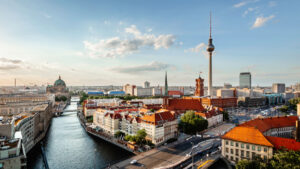
After a week steeped in Bavarian charm, we went to Berlin for a completely different vibe: imposing Soviet-era buildings juxtaposed with modern glass skyscrapers and traditional German architecture.
Brandenburg Gate and Reichstag
Our exploration of Berlin began at the iconic Brandenburg Gate. Standing beneath the imposing sandstone structure, we couldn’t help but feel a sense of history. A short walk away, the Reichstag Building, the seat of the German Parliament, offered a fascinating glimpse into the country’s political landscape. We joined a guided tour that delved into the building’s history, from its pre-war grandeur to its destruction during World War II and its subsequent reconstruction. A glass dome with a mirrored cone at its center lights the parliament chamber below—reminding lawmakers that the people are watching.
Haunting Echoes
Berlin doesn’t shy away from its dark past. The Topography of Terror, an open-air museum housed on the former grounds of the Gestapo and SS headquarters, was a sobering experience. The Holocaust Museum offered a deeper dive into this tragic chapter in history. The outdoor Memorial to the Murdered Jews of Europe is filled with grave-like pillars where it’s easy to get lost—on purpose.
Alexanderplatz and the Berlin Wall
Alexanderplatz, often referred to as “Alex,” is a bustling square in the heart of Berlin. Once a humble cattle market in the 19th century, it is now one of Berlin’s major commercial and transport hubs. The square is dominated by the Weltzeituhr (World Clock), a popular meeting spot that displays the time in major cities worldwide, as well as the iconic Fernsehturm—a TV tower built during the Soviet era while crosses were being removed from churches. When the sun hits the TV tower’s dome, it creates the image of a cross. This became known as the Pope’s Revenge.
A short walk away, we found ourselves standing before a poignant reminder of Berlin’s divided past. Remnants of the Berlin Wall, along with a section of the “death strip” that separated East and West Berlin, served as a chilling reminder of the city’s Cold War history. The adjacent Wall Museum told the story of the wall’s construction, its impact on the city and the eventual fall of the wall in 1989.
Munich and Berlin: A Perfect Pairing
Like beer and brats, Munich and Berlin complemented one another beautifully, painting a picture of modern Germany—a nation that remembers its past but marches into the future.
Eric D. Goodman is author of seven books. His most recent is “Faraway Tables,” a collection of poems focused on travel and a longing for other places. Learn more about Eric and his writing at EricDGoodman.com.