







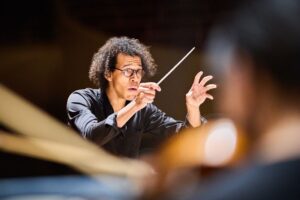
Early on, Jonathon Heyward was captivated by “the emotional depth and expressive power” of classical music.
“What drew me in was the idea that music could tell stories—complex, human stories—without words,” Heyward says. “Once I realized how limitless that expressive world was, I wanted to be part of it.”
A cellist since age 10, he was awestruck after having the opportunity in middle school to conduct his own string orchestra peer ensemble.
“Conducting became a natural extension of my musical curiosity. I was fascinated not only by individual lines, but by how an entire score comes together—how every musician contributes to the whole,” he explains. “I realized that conducting wasn’t just about interpretation: it’s about storytelling.”
During his high school years in South Carolina, Heyward dreamed of leading an American orchestra. His path to making that happen began at the Boston Conservatory of Music, where he became assistant conductor of both the opera department and the Boston Opera Collaborative.
At London’s Royal Academy of Music, he was appointed assistant conductor and (later) music director of the Hallé Orchestra and named a fellow.
Since then, he has become widely recognized as “one of the most exciting conductors on the international scene,” and been named to TIME Magazine’s ”Next Generation Leaders” and Bloomberg’s “Ones to Watch.”
Along with serving as Renée and Robert Belfer music director and artistic director of the Festival Orchestra of Lincoln Center, Heyward has conducted the New York Philharmonic, Chicago Symphony at the Ravinia Festival, and the symphonies in Atlanta, Detroit, Houston, Seattle, Dallas and Minnesota, among others.
He also guest conducts with the London Philharmonic, London Symphony, BBC Symphony, Royal Scottish National Orchestra, National Symphony Orchestra Ireland, City of Birmingham Symphony Orchestra, Royal Academy of Music and Scottish Chamber Orchestra.
Notably, Heyward’s most significant achievement came in 2022 when the Baltimore Symphony Orchestra (BSO) appointed him its first Black musical director and the nation’s youngest at age 29. He remains the only Black conductor currently leading a major U.S. symphony orchestra.
Since his official arrival in the 2023-24 season — marked by a three-day, statewide celebration featuring the Dance Theatre of Harlem — he has energized audiences, elevated the BSO’s artistic excellence and deepened its connection to the community.
Under his leadership, nearly 30,000 patrons have experienced a classical concert for the first time, ticketed attendance has risen 58% and a broader and more diverse audience now fills seats at the Meyerhoff and Strathmore.
Heyward brings a bold perspective to orchestral leadership — not only by wearing Converse Chuck Taylor high-tops onstage, which earned him the moniker “Converse Conductor” — but also by championing living composers, elevating women and AAPI artists and introducing cross-genre collaborations that connect with Maryland’s varied audiences.
“What motivates me is the belief that music has the power to bring people together and create shared experiences that really matter,” Heyward says. “I mostly enjoy the collaborative process—working with musicians, composers and communities to build something meaningful.”
Along with building new bridges with guest artists and student musicians across the region, Heyward became the first BSO music director in a decade to lead a Midweek and Family concert, which was attended by 4,500 students and family members. For all these accomplishments, the BSO announced a three-year contract extension in October, ensuring Heyward’s artistic leadership through the 2030-31 season.
While his main residence is in London — where he met his wife and traded in his southern drawl for a posh British accent — Heyward looks forward to a continued presence in Baltimore, which he feels “has an incredibly rich and genuine classical music scene with a strong sense of engagement and curiosity among audiences, and a real pride in the city’s cultural life.”
“What stands out to me is how personal it feels—there’s a closeness between the orchestra and the community that’s very special,” he adds. “Baltimore listeners are open, thoughtful and willing to explore, which creates an exciting environment for a fulfilling artistic journey.”
It’s not just Charm City audiences that impress him, but the BSO itself, noting that “the musicians here are extraordinary—not just technically, but as communicators and collaborators.”
“I’m proud of the trust and momentum we’ve built together—artistically and institutionally strengthening our sound, expanding our repertoire and embracing programming that reflects a wide range of voices and perspectives.”
Moving forward, Heyward aspires “to commission and champion new works, to deepen our community partnerships and to ensure that the BSO continues to thrive as a modern, inclusive orchestra with a strong international presence.”
“There are major symphonic works I can’t wait to explore with our musicians, as well as innovative programs and collaborations that expand how and where we share music,” he says. “Our education and community initiatives are also growing in meaningful ways, and 2026 will really showcase that holistic vision.”
June will be especially busy for the BSO, hosting “Rigoletto” in the second installment of its Verdi Opera initiative, and also hosting the League of American Orchestras 81st National Conference. Baltimore Symphony Youth Orchestras and BSO OrchKids will play a visible role in the conference and Heyward will lead a special concert kicking off the America250 celebration.
To support the BSO’s mission and long-term financial health, Heyward will donate $125,000 — a portion of his annual conducting fee — over six years starting in the 2026-27 season. His contribution will fund programs that nurture emerging talent and educational initiatives that expand access to orchestral music and inspire the next generation of philanthropists.
“I’d love for people to feel that the BSO is their orchestra. Classical music isn’t something reserved for a select few—it’s a living art form that belongs to everyone,” he says. “Whether you’re new to the concert hall or a lifelong listener, there’s a place for you here.
It’s the beauty of what we do.”
For more information about the BSO and upcoming performances, visit bsomusic.org.
Caryn R. Sagal is a Baltimore-based freelance writer.